
Insights
How to Build a Digital Transformation Roadmap: Now, Next, Future
Tom Holt ·
- Digital Transformation
- Roadmap
- Strategy

Short answer: A digital transformation roadmap should be sequenced in three horizons. NOW removes the highest-value customer and operational friction within about 90 days. NEXT builds the capabilities the future state requires. FUTURE keeps the organization adaptable as customer behavior, technology, and competitors change. Each horizon has an owner, a baseline, and a decision gate.
Why most roadmaps don’t survive contact with the business
A typical roadmap is a list of platforms arranged on a timeline. It looks organized and says nothing about what gets better for customers or the P&L. It also has no way to adjust when priorities shift, which they will.
A useful roadmap does three jobs. It shows what changes for customers and employees. It sequences work by value and dependency. It makes decisions visible, so leadership can stop, continue, or redirect with evidence.
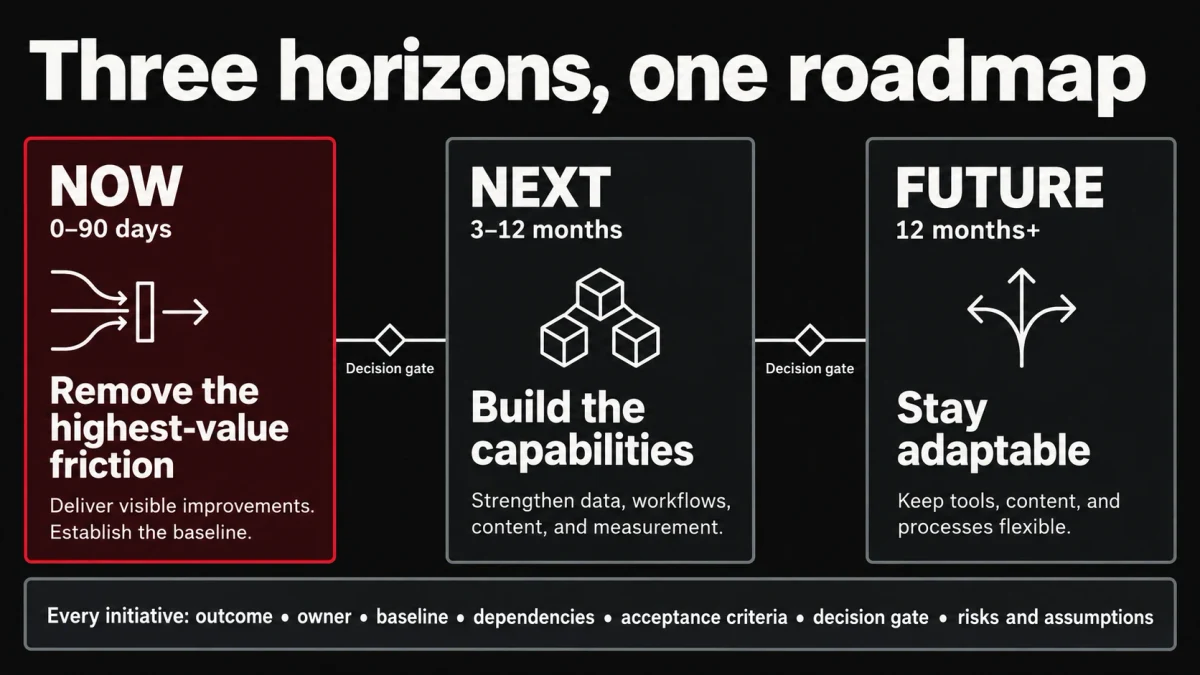
The three horizons
NOW: remove the highest-value friction (0 to 90 days)
Start where the business is losing money, time, or trust today. Examples in a dealer-distributed company:
- Leads that sit unassigned for hours because routing rules are manual
- Product pages that can’t answer a basic spec or availability question
- Service appointment requests that arrive by form and are re-keyed by hand
NOW work should be small enough to finish and visible enough to build confidence. It also produces the first real baseline data you will use for everything after.
NEXT: build the capabilities the future state needs (3 to 12 months)
Once early friction is removed, invest in the capability underneath it: a clean customer record, a governed content workflow, a measurement model leadership trusts. Capabilities are what let the next ten improvements happen faster and cheaper.
This is where platform decisions belong. By now you know the workflow and data requirements, so you buy to a spec instead of buying a promise.
FUTURE: stay adaptable (12 months and beyond)
You can’t predict every shift in customer behavior, regulation, or AI capability. You can avoid decisions that lock you out of responding. Favor open standards, API-friendly tools, portable content, and documented processes. The FUTURE horizon is less a list of projects than a set of design constraints applied to every NEXT decision.
How to prioritize inside each horizon
Rank candidate initiatives in this order:
- Customer impact
- Business value
- Strategic importance
- Capability leverage (does it make other work possible?)
- Effort and speed
Effort is last on purpose. Teams that start with “what’s easy” end up with a roadmap of low-impact quick wins.
What each roadmap item must include
If an initiative can’t fill in this table, it isn’t ready for the roadmap.
| Field | Question it answers |
|---|---|
| Outcome | What measurable result changes? |
| Owner | Who is accountable for it? |
| Baseline | What is the number today, and who verified it? |
| Dependencies | What must exist first (data, access, decisions)? |
| Acceptance criteria | How will we know it’s done? |
| Decision gate | When do we continue, change course, or stop? |
| Risks and assumptions | What are we inferring rather than knowing? |
Governance that keeps it alive
A roadmap is a living decision tool, not a document. Review it monthly with a short agenda: what shipped, what moved against the baseline, what we learned, what changes. Keep a decision log. When an assumption turns out wrong, record it and adjust the plan rather than defending the original.
Common mistakes
- Starting with a platform selection. Select the platform after the workflow is mapped.
- Treating NEXT as a dumping ground. If it has no owner and no outcome, it isn’t on the roadmap.
- Skipping enablement. Training, documentation, and handover are part of the build, not an afterthought. The goal is capability the client can run without dependency on a consultant.
- No stop rule. Every initiative needs a condition under which you’d end it.
Next step
If you have a roadmap that reads like a vendor list, rebuild it around outcomes and horizons. Rogue’s Digital Transformation Roadmaps engagement does this in a short, structured sprint. Schedule a Strategy Session to review where your current plan sits.
Sources
- Rogue Digital Group, Rogue Advantage Framework (NOW / NEXT / FUTURE horizon model and prioritization order).
- McKinsey & Company, The state of AI in 2025: workflow redesign as a leading correlate of impact.
See also: Why Digital Transformation Programs Fail · How to Measure Digital Transformation ROI
Frequently asked questions
- What is a digital transformation roadmap?
- It's a sequenced plan that connects business outcomes to the process, data, technology, and organizational changes required to achieve them, with owners, measures, and decision points.
- How long should a digital transformation roadmap cover?
- Plan in detail for the next 90 days, in outline for 12 months, and as design principles beyond that. Detailed multi-year plans go stale quickly.
- What should be in the first 90 days?
- The highest-value friction you can remove with the capacity you have: a broken lead handoff, a slow content approval, an unreliable report. Pick work that produces a baseline and a visible result.
- Who should own the roadmap?
- A single executive sponsor who can resolve cross-functional trade-offs, supported by a program lead who runs the monthly review and decision log.