
Insights
Why Digital Transformation Programs Fail (and the Order That Fixes Them)
Tom Holt ·
- Digital Transformation
- Strategy
- Operating Model

Short answer: Digital transformation programs fail when an organization buys technology before it defines the business outcome, the owner, and the process the technology is supposed to change. The software goes live. The work stays the same. Fixing that means reversing the order: outcome first, technology near the end.
The pattern: the tool ships and the work doesn’t change
A company replaces its website, installs a new CRM, or licenses an AI platform. The project is declared complete on launch day. Six months later the sales team is still working leads from a spreadsheet, marketing still can’t say which campaigns produced revenue, and the new platform is used for about a tenth of what was purchased.
That is not a technology failure. The system did what it was configured to do. Nobody changed how people work, who owns the result, or what gets measured.
If your CRM doesn’t change how sales follows up, it isn’t a transformation. It’s software.
What the data says about the gap
The adoption numbers look healthy. The impact numbers don’t.
- McKinsey’s 2025 global survey of 1,993 respondents found 88% of organizations use AI in at least one business function. Only 39% attribute any EBIT impact to it, and about 6% qualify as “high performers” with 5% or more of EBIT coming from AI.
- The same survey found high performers were nearly three times as likely to have fundamentally redesigned individual workflows. Redesign, not the model or the vendor, was among the strongest correlates of impact.
- Gartner’s 2022 martech survey of 324 marketers found they were using 42% of their stack’s capabilities, down from 58% in 2020. The most cited barriers were overlapping tools (30%), recruiting talent (28%), and ecosystem complexity (27%).
Spending isn’t the constraint. Ownership and process design are.
Five failure patterns we see repeatedly
1. Technology is treated as the strategy. The brief says “implement platform X” instead of “cut quote-to-appointment time in half.” Any platform can be implemented. Only an outcome can be achieved.
2. No single owner for the result. Marketing owns the website, IT owns the CRM, sales owns follow-up, and nobody owns the customer journey that crosses all three.
3. The process is carried over unchanged. The old manual handoff is rebuilt inside the new tool. Teams then work around it, because the workflow was the problem.
4. Data is deferred. Duplicate records, unmapped fields, and missing consent flags are “phase two.” Phase two never funds, and every report built on that data is quietly wrong.
5. Measures are chosen after launch. If the baseline wasn’t captured before the change, no one can prove the change worked. Then the first budget review becomes an argument about opinions.
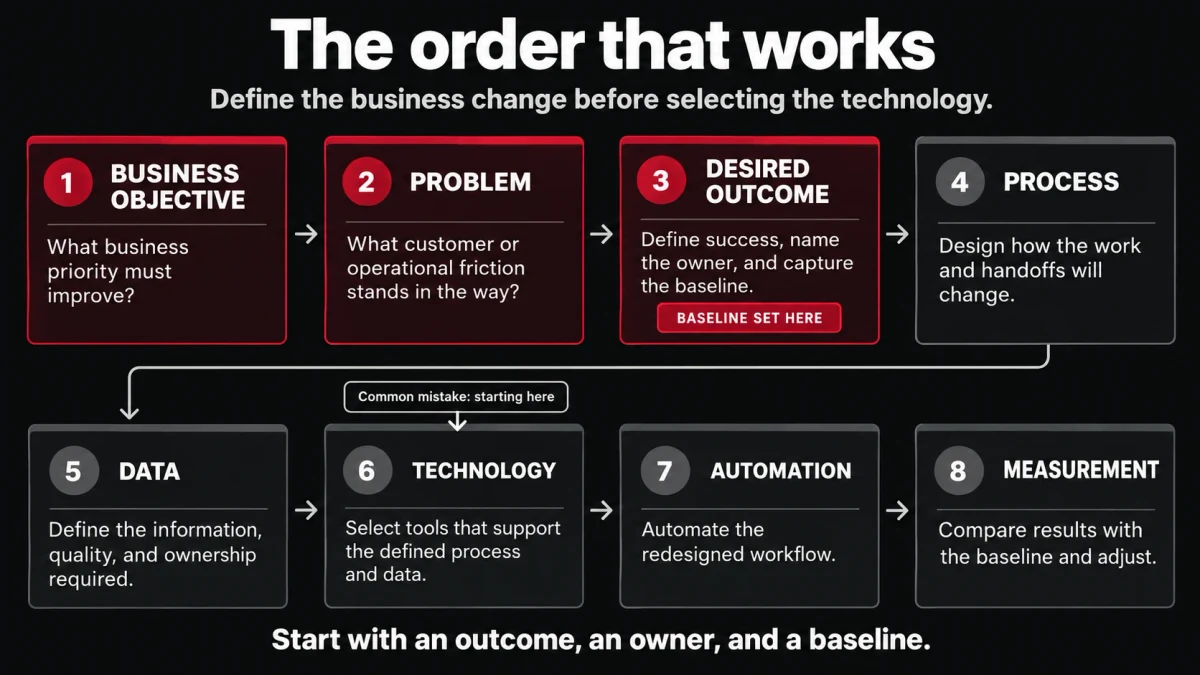
The order that works
Technology is an enabler, so it goes late in the sequence:
- Business objective
- Customer or operational problem
- Desired outcome
- Process
- Data
- Technology
- Automation
- Measurement (baseline set at step 3, not step 8)
Most failed programs start at step 6. Most successful ones spend their first weeks on steps 1 through 3 and make the later steps shorter and cheaper as a result.
A 30-minute diagnostic
Put these five questions to your leadership team. If you can’t answer more than two with a name and a number, you have a coordination problem, not a technology problem.
- Which single business outcome is this initiative accountable for?
- Who is the one person who loses sleep if it misses?
- What does the process look like on paper today, and what will be different next quarter?
- What is the baseline metric today, and who confirmed it?
- Which data does this depend on, and who owns its quality?
What this looks like in dealer-driven industries
In RV, marine, and powersports, a transformation crosses the manufacturer, the dealer, and the owner. A lead can start on the OEM’s site, be routed to a dealer’s CRM, and end in a service bay three years later. If the program is scoped to one system, the handoffs between them stay broken. Start from the role of the person in each moment (shopper, salesperson, service advisor) and work back to the capability required. That approach is described in more detail in the Role-to-Capability Method.
Where to start
Pick one outcome that matters to revenue or retention, name an owner, and capture the baseline this week. Then decide what, if anything, needs to be bought. Start a Transformation Assessment and we will map where your current systems, data, and workflows are working against that outcome.
Sources
- McKinsey & Company, The state of AI in 2025: Agents, innovation, and transformation (survey June 25 to July 29, 2025).
- Gartner 2022 Marketing Technology Survey, as reported by Chief Marketer (October 2022).
See also: Digital Transformation Roadmaps · How to Build a Digital Transformation Roadmap: Now, Next, Future
Frequently asked questions
- Why do digital transformation projects fail?
- They fail when technology is chosen before the outcome, owner, and process are defined. The platform launches but the workflow around it is unchanged, so behavior and results stay the same. Weak data and missing baselines make the problem harder to see.
- How long does digital transformation take?
- Meaningful early results can show up in 90 days if the first phase targets one high-friction outcome. A full operating model change usually runs in phases over 12 to 24 months. A roadmap that promises everything at once is a warning sign.
- What is the first step in a digital transformation?
- Define one business outcome with an owner and a baseline measure. Everything else (process, data, tools) is selected to serve that outcome.
- How do you know a transformation is working?
- You can point to a changed process, a team that has adopted it, and a measured improvement against the baseline. A launched system is evidence of work performed, not evidence of transformation.