Insights
The Role-to-Capability Method: Design the Business Behind the Experience
Tom Holt ·
- Frameworks
- Customer Experience
- Operating Model
Short answer: The Role-to-Capability Method starts with a person’s role and what they are trying to accomplish, identifies the friction in the way, and then works backward to the business capability, including people, process, data, and technology, needed to remove it. It keeps customer experience and the operating model behind it in the same conversation.
The problem it solves
Most experience work stops at the visible layer. A team redesigns a quote request page, shortens the form, and celebrates when completion rises. Then the lead lands in a queue nobody monitors and the shopper waits three days for a reply. The page improved. The experience didn’t.
Visible experience is the output of an operating capability. If you change one without the other, the customer feels the weaker of the two.
The method in one line
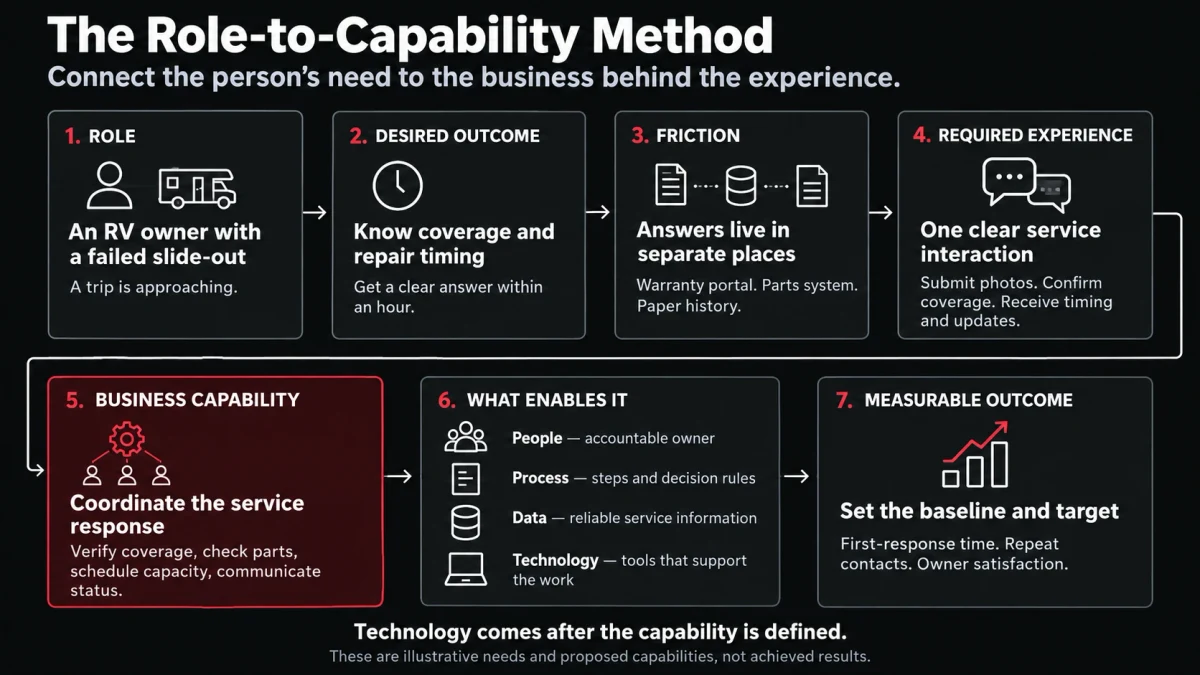
Role → desired outcome → friction → required experience → business capability → people + process + data + technology → measurable outcome
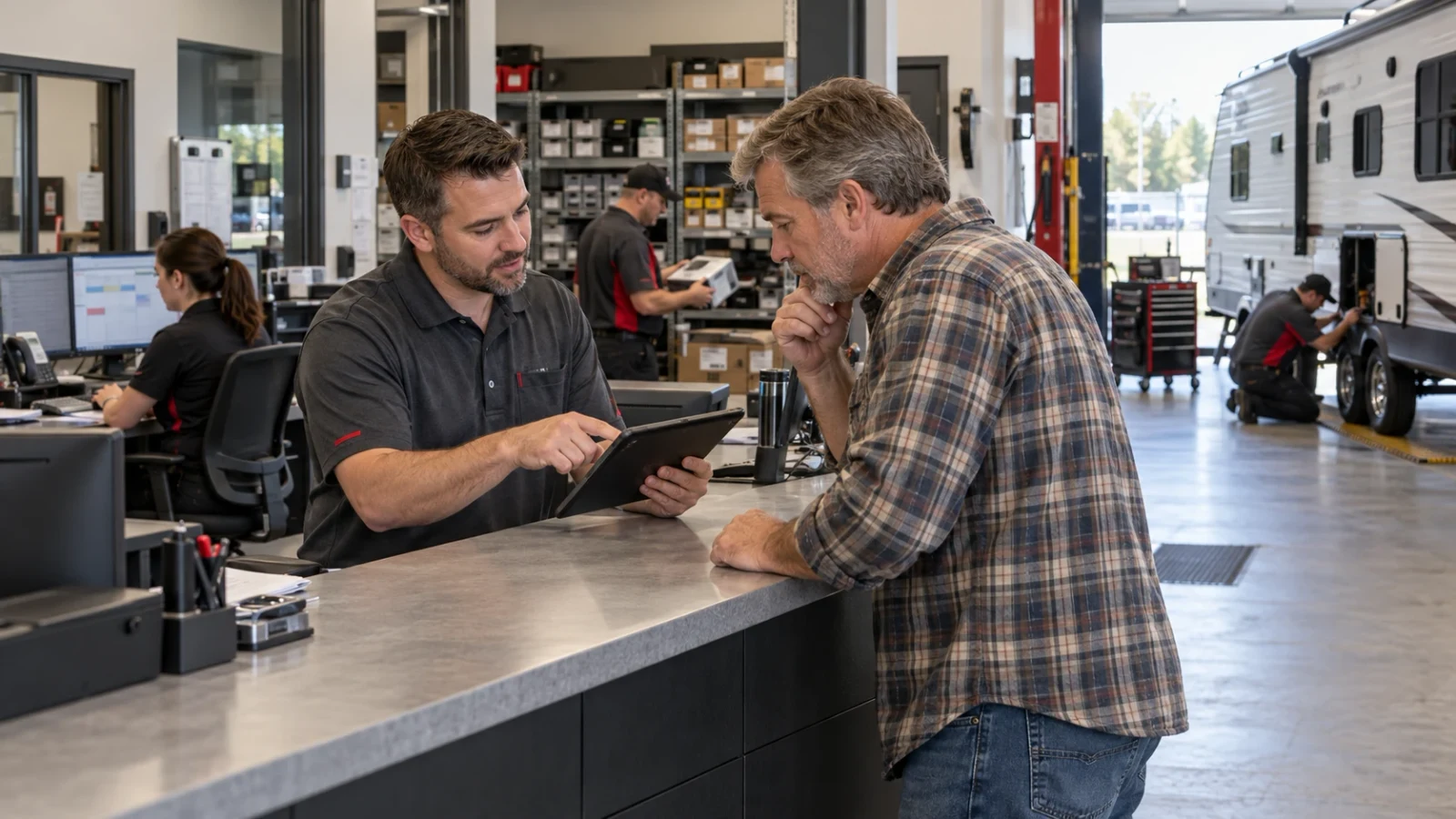
Walk through each step with a concrete case: a service advisor at an RV dealer.
1. Role
Name the person and the job they are doing in the moment. Not “customer,” but “a first-time towable owner whose slide-out fails on a Friday before a trip.” Different roles want different things from the same business: shopper, owner, dealer principal, salesperson, technician, distributor, employee.
2. Desired outcome
What does success look like for that person? The owner wants to know within an hour whether the repair is covered and when the unit will be ready. The advisor wants to answer that without calling three systems.
3. Friction
Find where the business makes the outcome harder. Warranty status lives in the manufacturer’s portal. Parts availability lives in the dealer system. The customer’s history lives in a binder. Quantify the cost: minutes per call, abandoned appointments, repeat contacts, lost trust.
4. Required experience
Describe the experience that would remove the friction. The owner submits the issue with photos, sees coverage status, and receives a realistic ready date and updates by text.
5. Business capability
Define what the organization must be able to do reliably to deliver that experience: verify coverage, check parts availability, schedule against technician capacity, and communicate status. Capabilities are things the business does, not tools it owns.
6. People, process, data, technology
Only now map what each capability needs:
- People: who owns it, what skills they need
- Process: the steps and decision rules
- Data: which fields, from which systems, how clean
- Technology: what supports it, and whether you already own it
Technology is the last box, not the first.
7. Measurable outcome
Set the baseline and target before building: first-response time, appointment completion, repeat-contact rate, owner satisfaction after service.
Why it works better than journey maps alone
Journey maps describe what the customer experiences. They rarely say who is accountable for each moment or what has to exist behind it. The Role-to-Capability Method forces that link. It also surfaces cross-functional gaps early, because one role’s outcome typically touches marketing, sales, service, parts, and IT.
Prioritizing the work
Once capabilities are mapped, rank them:
- Customer impact
- Business value
- Strategic importance
- Capability leverage, meaning whether fixing it makes other work possible
- Effort and speed
A shared capability, such as a clean owner record, often scores highest because it supports sales, service, and marketing at once.
Using it in a workshop
Run a 90-minute session with the people who actually do the work:
- Pick one role and one outcome.
- Walk the real process, not the documented one. If it’s possible, go observe it first.
- List every handoff and every workaround.
- Write the capability statement: “The business can [verb] [object] within [time] with [accuracy].”
- Assign an owner and a baseline metric.
When the dashboard and the floor disagree, trust the floor and investigate.
Where to go next
If you’re planning a website, CRM, or AI initiative, run this method on the single most important role first. It will tell you what to build and what not to buy. See how it fits in Customer Experience Transformation, or Schedule a Strategy Session to run it on your highest-friction journey.
Sources
- Rogue Digital Group, Rogue Advantage Framework and Role-to-Capability Method (internal methodology).
See also: Why Digital Transformation Programs Fail · How to Build a Digital Transformation Roadmap
Frequently asked questions
- What is the Role-to-Capability Method?
- It's a diagnostic and design method that starts with a person's role and desired outcome, finds the friction, and works back to the business capability and the people, process, data, and technology needed to make the outcome reliable.
- How is it different from a customer journey map?
- A journey map documents the customer's experience. This method connects each moment to the capability, owner, data, and measure behind it, so the experience can be built and sustained.
- Can it be used for employees and dealers, not just customers?
- Yes. Dealer principals, salespeople, technicians, and internal staff are all roles with outcomes and friction. Many of the biggest gains come from fixing internal roles.
- What is a business capability?
- A capability is something the organization can do repeatedly and well, such as "verify warranty coverage in under five minutes." It combines people, process, data, and technology.